Interactive

Catch and Collect: The Forest of Extinction - 映像作家: teamlab
Art workInstallationInteractiveMovie

Catch and Collect: The Forest of Extinction

2025
00:02:15
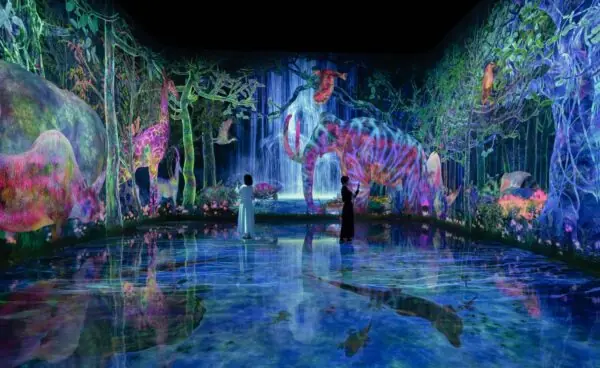
An educational project conceived as a way to explore, discover, catch, observe, gather knowledge, and expand curiosity with one’s own body. In the Forest of Extinct Animals, extinct animals live. When you approach or touch the animals, they run away or turn around. You catch various kinds of extinct animals, observe them, and build your own collection encyclopedia. Using the smartphone camera, you look at the animals walking through the space, and when you cast the “eye of observation” at the animal visible on the screen, it flies into the real space. When the “eye of observation” hits the animal, it disappears from the space and enters your smartphone, where it is collected. When you swipe a captured animal to a place visible through the camera, it is released and returns to that spot. Also, if you cast an “observation net” wherever you like, an “observation net” will be spread at your feet. Working together with the people around you and using your body to drive the animals into the “observation net,” the animals disappear from the space and are collected in the encyclopedia in the same way. The collection encyclopedia fills in more detailed information the more times you catch the same animal. Work page: An educational project conceived as a way to explore, discover, catch, observe, gather knowledge, and expand curiosity with one’s own body. In the Forest of Extinct Animals, extinct animals live. When you approach or touch the animals, they run away or turn around. You catch various kinds of extinct animals, observe them, and build your own collection encyclopedia. Using the smartphone camera, you look at the animals walking through the space, and when you cast the “eye of observation” at the animal visible on the screen, it flies into the real space. When the “eye of observation” hits the animal, it disappears from the space and enters your smartphone, where it is collected. When you swipe a captured animal to a place visible through the camera, it is released and returns to that spot. Also, if you cast an “observation net” wherever you like, an “observation net” will be spread at your feet. Working together with the people around you and using your body to drive the animals into the “observation net,” the animals disappear from the space and are collected in the encyclopedia in the same way. The collection encyclopedia fills in more detailed information the more times you catch the same animal. Work page: https://www.teamlab.art/jp/ew/collecting-forest-planets/planets/
Multi-Jumping Universe - 映像作家: teamlab
Art workInstallationInteractiveMovie

Multi-Jumping Universe

2022〜
00:01:29
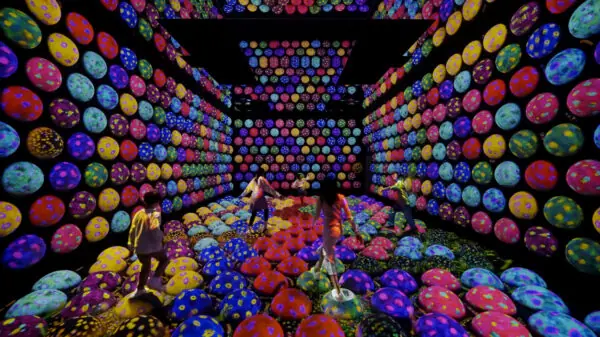
Description: “Multi Jumping” is an elastic floor that lets you bounce. The ground beneath you sinks, and you can jump higher than usual. When you step on “Multi Jumping,” the floor beneath your feet sinks, creating a distortion in space-time where stardust gathers and a star is born. If you bounce on the star, it begins to move. By continuing to bounce on the moving star as you chase it, the star grows and you experience the life of a star. When a star reaches the end of its life, it turns back into stardust, becoming the source of a new star. When it grows extremely large, the star becomes a black hole, drawing in the surrounding stardust and stars. Background of the work The life of a star Stars that emit their own light, like the sun or the stars shining in the night sky, are called “stars.” In the universe, there are many different kinds of stars, such as “planets,” like Earth, on which we live, and “satellites,” like the moon, that orbit around them. Here, however, we will talk about “stars” that emit their own light. A key factor in the life of a star is “gravity.” According to Einstein’s theory, in the universe, the mass of objects creates distortions in space-time. The force that causes surrounding objects to gather as if drawn toward these distortions in space-time is called “gravity.” The birth of a star In the universe, vast amounts of stardust and gas drift about, and when they gather under gravity, they form the embryo of a star. The state immediately before something becomes a star is called a “protostar.” The evolution of a star A “protostar” gathers surrounding stardust and gas through gravity and evolves into a shining star. A star at this stage is called a “main-sequence star.” Stars spend most of their lives as main-sequence stars. The sun we see is currently at this stage. As it evolves further, the star begins to swell and becomes a large red star called a “red giant.” The end and rebirth of a star If a star has a mass less than about eight times that of the sun, it releases gas and ends its life. If it is more massive than that, it ends its life in a “supernova explosion.” A star is blown apart by a supernova explosion, turning back into stardust and gas, which then becomes the material for the birth of the next star. Work page: https://www.teamlab.art/jp/ew/multijumpinguniverse-planets/planets/
∈Y∋ + C.O.L.O. — A/V Live Performances (2025-2026) - 映像作家: cosmiclab
3DCGArt workAudio visual performanceCodingExperienceInstallationInteractiveLive actionMusic VisualizationPerformancePixel ArtReal-time GraphicsVJ

∈Y∋ + C.O.L.O. — A/V Live Performances (2025-2026)

2025〜
00:00:35
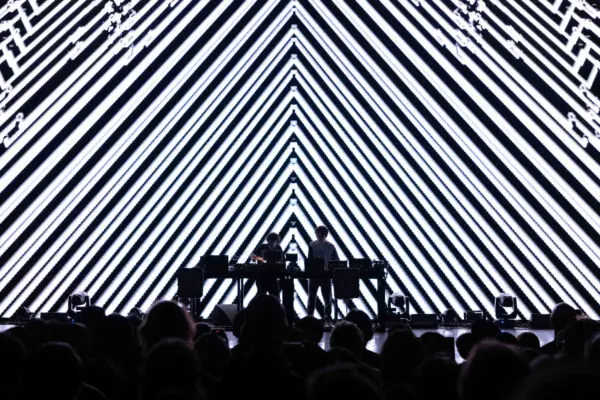
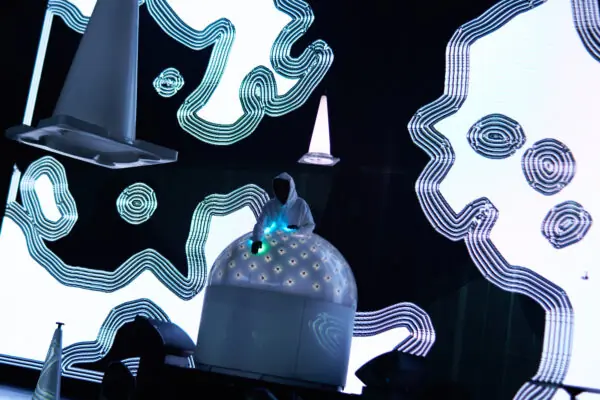
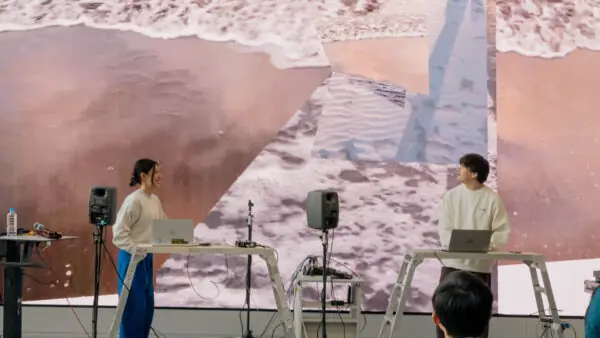
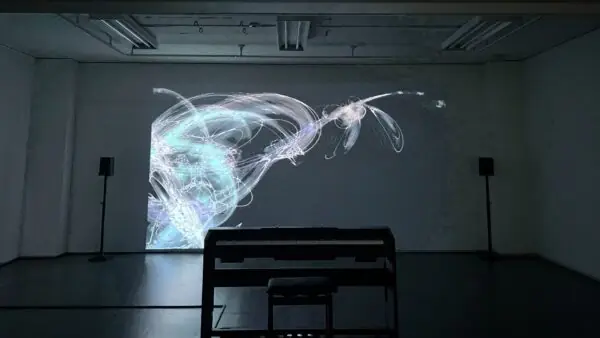
∈Y∋とC.O.L.OによるA/V Live ユニット。世界各都市で公演を繰り広げる。 ■ Performances (2025-) Art Week Tokyo— Tokyo, Japan November 15, 2025 / FACETASM MUTEK.JP — Tokyo, Japan November 21, 2025 / Nocturne 1 Powerhouse: International — A New Arts Festival — Brooklyn, New York, USA December 5, 2025 Powerhouse: International A New Arts Festival CTM FESTIVAL — Berlin, Germany January 24, 2026 / Berlin, at Haus der Visionäre REWIRE FESTIVAL —The Hague, Netherlands April 10, 2026 Variations festival — Nante, France April 11, 2026 ∈Y∋は1986年にBoredomsを立ち上げ『Super æ』や『Vision Creation Newsun』などジャンルを打ち壊す作品を世に送り出し、世界中にファンを持つ存在となっている。また、ドラマーを集めて挑んだ壮大な「Boadrum」シリーズでも知られている。Sonic YouthやJohn ZornのNaked Cityのほか、Puzzle Punksなどのプロジェクトにも参加している。 本プロジェクトは、マルチメディアA/VコレクティブCOSMIC LAB創設者でもあるビジュアルアーティストC.O.L.OとのA/Vショーである。C.O.L.Oはテクノ元祖Jeff Millsとの合作『THE TRIP - Enter the Black Hole』や、∈Y∋との『FINALBY()』などで未知のAV体験を作り上げてきており、ヴィジュアルの構造がサウンドを生成し形作る統合システムを開発してきた。音と映像を切り離せない一つのメディアとして扱い、その場ならではの、人を変容させるような体験を生み出している。 AV/DJ/LIVE という枠を超えた加速的なハイブリッド、マキシマイズの先に立ち顕れるミニマライズ 。拡張されたシンゲリフューチャリズムや地殻原子オーディオ・ヴィジュアル・リアクティブで映像・光の不可分を加速。 A swarming bundle of chaos and fun surrounds Yamantaka Eye, aka ∈Y∋, the visionary founder of legendary avant-noise groups Boredoms, Hanatarash, and Puzzle Punks. Working since the 1980s, ∈Y∋'s output has influenced and shaped experimental music in his native Japan and across the globe. From noise and psychedelia to performance art and visual art, ∈Y∋'s career is a collage of creative mischief and devilish collaborations. He has performed with the iconic Sonic Youth, on John Zorn’s Naked City (1990), and with the influential South Korean artist Nam June Paik, among many others. Expect a face-melting and mind-warping audiovisual battery as the mutant cyberkinetic noise of ∈Y∋ is combined with the rampant visuals of C.O.L.O from Osaka’s Cosmic Lab to birth an immersive audiovisual performance. Through projects such as FINALBY( ) with ∈Y∋, C.O.L.O has developed integrated systems in which visual structures generate and shape sound, treating audio and image as a single, inseparable medium to create site-specific, transformative experiences.
Expo 2025 Osaka, Kansai Signature Pavilion “null²” - 映像作家: wow-inc
3DCGAIAudio visual performanceEventExperienceInstallationInteractive

Expo 2025 Osaka, Kansai Signature Pavilion “null²”

2025
00:01:45
WOW participated in the signature pavilion “null²” at Expo 2025 Osaka, Kansai as part of the creator team, contributing to the planning, visuals, sound, and overall direction system. The pavilion’s theme is “Polishing Life.” WOW joined as a direction member from the earliest planning stages and, together with Expo producer Yoichi Ochiai, spent several years creating a wide range of creative elements, from the pavilion’s interior visuals, sound, robot control, and experiential flow to the exterior visuals. A Pulsating Sculpture, a Conversational Space For this pavilion, Ochiai established “two mirrors” as a key concept. The first refers to the sculpture itself, which generates unfamiliar landscapes. Its mirror-finished exterior absorbs the surrounding scenery, pulsating as it repeatedly transforms like a living organism, even as a building. The second refers to the experience inside the pavilion. In a space where mirrors and imagery are integrated, visitors confront “kigō*” and engage in dialogue with a digital human. WOW was primarily responsible for this interior experience. The space confronting “kigō” is a cube measuring 8 meters in width, depth, and height, with mirrored surfaces on all sides. Projection systems on the ceiling, floor, and walls, together with a vertical video object called the “Monolith” standing at the center, work in response to one another to depict “kigō,” creating endless reflections. In addition, the cube-shaped mirrored “goshintai,” which symbolizes the space, moves freely overhead, shifting perspectives and stirring the visitor’s mind and thoughts. Using mirrors as a medium, the experience moves back and forth between meaning and matter, self and other, reality and virtuality, encouraging visitors to reconsider and reinterpret what life is and offering a prompt to “polish life.” *Elements that constitute a person’s individuality, such as their name, hobbies, preferences, voice, and appearance Two Types of Experiences, Two Different Perspectives The experience is offered in two modes: “Dialogue Mode” and “Installation Mode.” Dialogue Mode centers on the world of “computational nature,” as proposed by Ochiai, and the story connected to it, allowing visitors to let go of their “kigō” through verbal communication. In Installation Mode, visitors view simple patterned visuals, along with the Monolith and goshintai moving throughout the space, from the outer corridor, creating a non-verbal experience that lets them intuitively sense the structures at the essence of life. In both experiences, the story, visuals, sound, goshintai, and Monolith are all intricately linked, so WOW worked closely with Ochiai to craft a precise direction. Direction Where Technology and Expression Merge On the technical side, to create a more three-dimensional and densely layered experience, WOW integrated a wide range of direction elements, including AI-generated real-time video, display of 3D Gaussian splatting, sound generation, image effects, as well as the display and speech of MirroredBodies created by visitors in a dedicated app, and robot control for the goshintai and Monolith. In collaboration with various companies, WOW developed the main system that aggregates and controls these elements. In addition, the carefully designed sound direction, which makes use of characteristics across different frequency ranges, contributed to a unique auditory experience. Logo Design and Design Guidelines That Create Organic Expression WOW also handled the logo design for null². For the dynamic logo, multiple fonts were used to create a design that transforms into various forms. The static logo was refined from the dynamic logo as the official version. In both cases, the aim was to maintain a certain degree of legibility while pursuing a fluid, life-like design tone through verification and rule setting. In this project, the participating teams, including WOW, brought together all of their technical capabilities and creativity to create the work “null²,” something that could only have been realized at the Expo.
Order in Chaos - 映像作家: teamlab
Art workInstallationInteractiveMovie

Order in Chaos

2025
00:01:45
Color strokes are not grasped as a whole by anyone, nor are they directed, nor are they influenced from outside. As simple interactions arise locally between strokes, or between strokes and people, order continues to emerge on its own while moving toward disorder. Even if each one is separated in time and space, once order emerges among them, the constituent elements transcend spacetime and appear as a single existence. And even if their shapes and sizes undergo major superficial changes, or if the constituent elements are replaced, this spacetime existence is maintained. This spacetime existence is part of the sea of disorder, is swallowed up by the sea of disorder, and yet continues to be born again from the sea of disorder. Order and disorder, existence and the whole, have no boundaries and are continuous; they collide and blend together, yet keep rising and receding. Images created through lenses and perspective are spatial illusions that render three-dimensional space on a two-dimensional plane. Three-dimensional space appears beyond the two-dimensional plane, and that three-dimensional space and the viewer are separate spaces, with the two-dimensional plane serving as the boundary. The viewpoint is fixed, and the body is lost. Unlike these, this work is not a spatial illusion; the work space exists as it is in the same space as people’s bodies. Walls and floors do not become boundary surfaces between the viewer and the work space; the work space becomes one with the space occupied by people’s bodies. The viewer’s viewpoint is not fixed, and the body is free. Work page: https://www.teamlab.art/jp/ew/order-chaos-phenomena/phenomena/
A Massless Sun and a Sun of Darkness - 映像作家: teamlab
Art workInstallationInteractiveMovie

A Massless Sun and a Sun of Darkness

2022〜
00:01:45
We do not perceive the world we see. We see the world we perceive. Countless spheres of light. As people approach the spheres of light, they shine more intensely, and the surrounding spheres respond in turn, continuing one after another. If you widen your field of view and stare, spheres of darkness, like lumps of darkness that has solidified, also begin to appear. However, these spheres of light and darkness do not exist. The spheres of darkness do not even appear on camera. Nothing such as glass or any other object is present on the surface of the spheres of light; these spheres are made only of light. There is no material boundary surface, and the boundary between the sphere and the body remains ambiguous in perception. However, in this universe, light does not solidify, and it never forms into spherical masses by itself. In other words, these spheres of light do not exist. These spheres are not present in the physical world, but are sculptures that exist in the world of perception: "Cognitive Sculpture / Sculptures of Perception." Their material consists of light, the environment, the body, and perception. Shaped by the experiencer’s own dynamic body and perception, they appear and exist in the experiencer’s own perceptual world. When they exist in perception, that is existence. And the spheres cannot exist even in the world of perception on their own; they are created by the environment. The phenomena produced by the environment are the existence of the work. Work page: https://www.teamlab.art/jp/ew/masslesssuns-phenomena/phenomena/
teamLab Phenomena Abu Dhabi - 映像作家: teamlab
3DCGArt workInstallationInteractiveMovie

teamLab Phenomena Abu Dhabi

2025
00:05:27
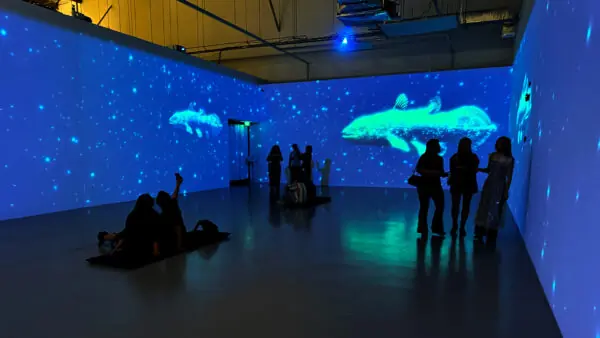
Environment gives rise to phenomena, and phenomena create the work. Immersed in that new body of works, one becomes one with the environment. The work cannot exist on its own; environment gives rise to phenomena, and phenomena create the work. Pebbles and the things humans have made until now have been objects. Objects possess a stable structure in themselves and, separated from the outside world, continue to exist even when placed inside a sealed box. A vortex born in the sea, on the other hand, disappears the moment it is transferred into a closed box. A vortex does not maintain its structure by itself; it exists only within the flow created by its environment. It is formed by water that continuously flows from outside to inside, and from inside to outside, changing along with the flow. Its contours are indistinct, and there is no material difference between the vortex and the world outside it. Rather than making objects, create a special environment, and create works through the phenomena that environment brings forth. Let us call this “environmental phenomena.” Works cannot be separated from their environment; they change as the environment changes. Works are liberated from the material objects that have so far carried their existence. Even the ordinary things of everyday life—air, water, light—will become phenomena through unique environments, transforming into a new kind of existence. Transcending the common sense of what humans have made until now, works will retain their existence even when people enter them bodily, and will be repaired when broken. The boundaries of a work’s existence are indistinct and continuous with what lies outside it. However, if the environment is lost, the work will disappear. Human consciousness will expand from existence itself to the environment. Exhibition details: https://www.teamlab.art/jp/e/phenomena/

Sign up for unlimited access to the video archive