Projection mapping

Projection Mapping and Lighting Show : Upopoy Kamuy Symphonia - 映像作家: JKDCollective
2D animation3DCGAnimationArt workAudio visual performanceEventExperimental filmImageInstallationMotion graphicsMusic videoOriginalProjection mappingShort film

Projection Mapping and Lighting Show : Upopoy Kamuy Symphonia

2020 ~
00:14:26
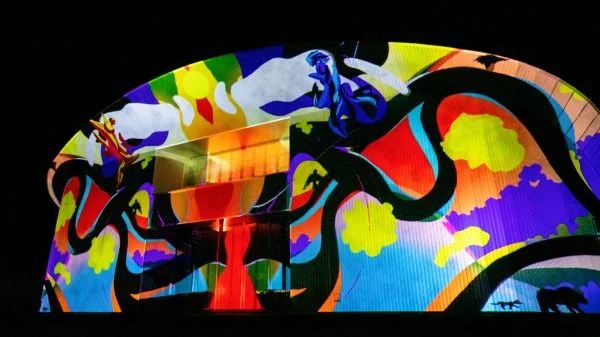
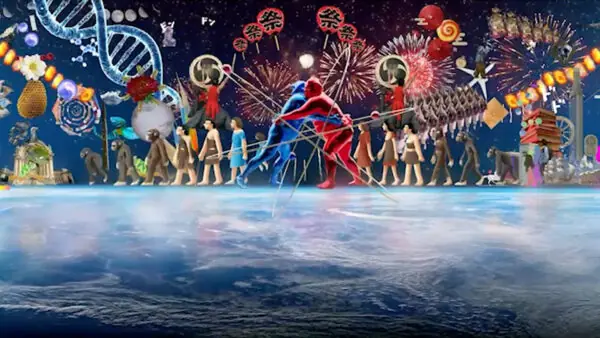
Japan’s first national facility dedicated to sharing the history and culture of the Ainu people, Upopoy, opened in Shiraoi, Hokkaido, on Sunday, July 12, 2020. It consists of a folk museum, an interactive field museum, and an Ainu coexistence park, and has drawn attention as a base for reviving and developing the fading Ainu culture. What JKD was in charge of this time was the highlight of Upopoy’s nighttime program starting on Saturday, July 18, 2020: a large-scale show combining projection mapping and lighting. It depicts the Ainu creation myth through a delicate yet dynamic hand-drawn full animation running for just under 14 minutes, synchronized with soul-stirring music and sound design. The visual work is projected mainly onto the walls of the dome-shaped Experience Exchange Hall, as well as the surrounding hills, river, and statues. Lighting placed throughout the vast grounds is tightly synchronized with the music and mapped visuals, creating a mystical spatial experience that draws viewers into the story. Among the audiovisual works JKD has produced so far, this is one of the top three. The music is by OKI, a musician internationally acclaimed for his work with the OKI Dub Ainu Band, and Kuniyuki Takahashi, also based in Sapporo and known worldwide for his activities. To pursue truly authentic expression, the four animators, Ryoji Yamada, Hana Ono, Yutaro Kubo, and Tatsuhiro Ariyoshi, took part in this serious collaboration. The opening and ending motion was handled by Shotaro Tomiyama and Ko Kudo of the JKD visual team, and the overall visual direction was by Shane Lester. The story unfolds through the Ainu creation myth in a vast site facing a beautiful lake. We believe we were able to create an experience that draws viewers in. If you ever have the chance to visit Hokkaido, please be sure to see it.

WOW25 "sonus-oleum ; Sonosorium" from Unlearning the Visuals - 映像作家: wow-inc
Audio visual performanceGenerative ArtInstallationInteractiveOriginalProjection mappingR&DReal-time Graphics

WOW25 "sonus-oleum ; Sonosorium" from Unlearning the Visuals

2022
00:03:23
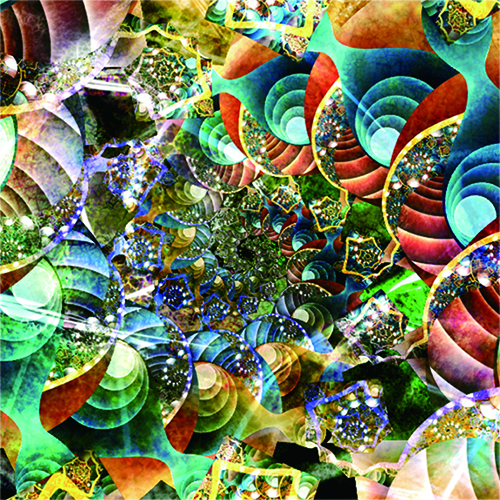
About the Work “sonus-oleum ; Sonosorium” is a live installation in which visitors can experience works in different forms on each of the three floors of the ship-shaped facility (T-LOTUS M): B1F, 1F, and the rooftop. With the premise that “music becomes the energy that moves the ship,” the work explores the form of music born inside the ship through the following four formats. Live Performance 1 — The Birth of Music — This work begins with a live performance on B1F. The music is an original piece composed by Fumitake Ezaki specifically for this live installation. The performance is by Fumitake Ezaki (piano), Shuntaro Tsuneta (violin), Sonoko Muraoka (cello), and an automatic piano. The venue was designed with eight 3 m × 4 m screens installed on both sides of the performers, enveloping visitors in music and imagery. Real-time motion graphics synchronized with the instruments were projected onto the screens. The elements composing the real-time motion graphics are the piano’s output of keyboard input (88 keys), the strength and duration of pedal presses, and the hand movements of the violin and cello players captured using ring devices. The real-time motion graphics linked to the performers’ movements depict the energy of music being generated and floating upward to the upper levels. Interactive Installation — Variation through Images — The energy of the music born in the B1F live performance appears as bubbles within the interactive work on 1F. Seven 2.4 m × 2.4 m translucent screens were installed throughout the 1F space in alignment with the windows, and interactive visuals were projected onto them. When visitors touch the bubbles displayed on each screen, the bubbles split, and each note of the original piece transforms into a different timbre. Variations born from chance continue to be generated endlessly. Projection Mapping — Music Creates Wind — The variations generated on 1F rise further to the rooftop, where they create the wind that moves the ship. Using four large 30,000-lumen projectors, the wind stirred up by the power of music and striking the sails was projected above the visitors’ heads. Live Performance 2 — A Session with Returned Sound — In the second live performance held on B1F, the automatic piano played in real time the variations generated by visitors touching the bubbles on 1F, while Ezaki (piano), Tsuneta (violin), and Muraoka (cello) improvised along with it. The interplay of visitor-generated variations, improvised live performance, and real-time motion graphics evoked a new form of music. Through these four processes, this live installation created a landscape in which sound was “unlearned” and transformed into new sounds, continuing in circulation. The title “sonus-oleum ; Sonosorium” is a coined word combining sonus, meaning sound, and petroleum, meaning oil.
Komyaku’s Dancing Garden, Komyaku’s Farewell - 映像作家: hirai
3DCGCo-CreationGenerative ArtInstallationProjection mappingReal-time Graphics

Komyaku’s Dancing Garden, Komyaku’s Farewell

2025
00:01:41
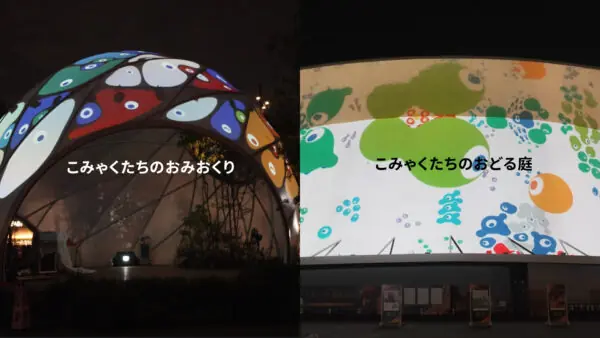
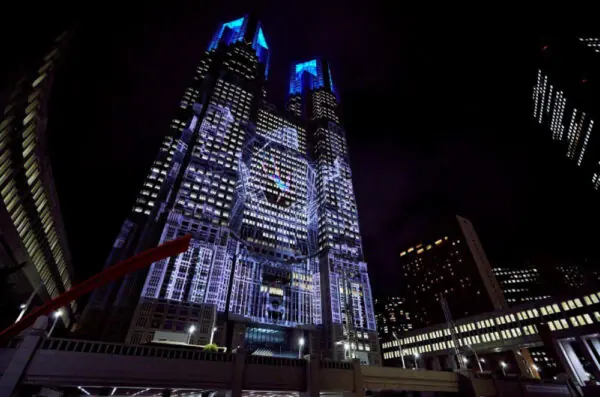
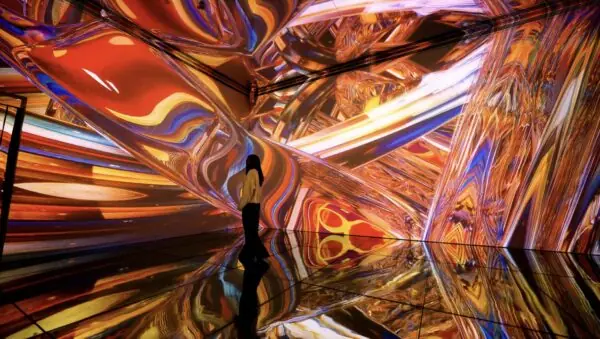
This work is a video piece that was exhibited and screened as part of an ambient projection-mapping presentation at the EXPO Hall “Shine Hat” and the Popup Stage East Outside at Expo 2025 Osaka, Kansai. Taking as its motif the “EXPO 2025 Design System” IDs, affectionately known as “Komyaku” at Expo 2025 Osaka, Kansai, and with Kohta Hikichi, a representative member of the team that created it, serving as an advisor, we drew on the expertise in artificial-life ecological systems that HiRai has long been researching to create a real-time video simulation system and visuals. In producing the video, we referenced the design system’s history of being prototyped based on metaballs, and developed a real-time simulator in which the Komyaku behave as if they were alive while retaining the identity of the design itself. By using GPGPU to calculate the interactions among large numbers of Komyaku in real time, we built a system that can be flexibly expanded to support a wide range of possibilities, including interaction and the generation of one-of-a-kind videos. At the Popup Stage East Outside, we also took advantage of the architectural characteristics of a structure in which the projected image is interrupted by support columns, and created visuals that made it look as though each steel beam were packed full of Komyaku. We pursued video production that made the most of the characteristics of the projection surface. The name “Komyaku” naturally spread as a nickname referring to the IDs that make up the design system. Taking into account this derivative, fan-created cultural expansion, this work intentionally uses the term “Komyaku.”

Sign up for unlimited access to the video archive