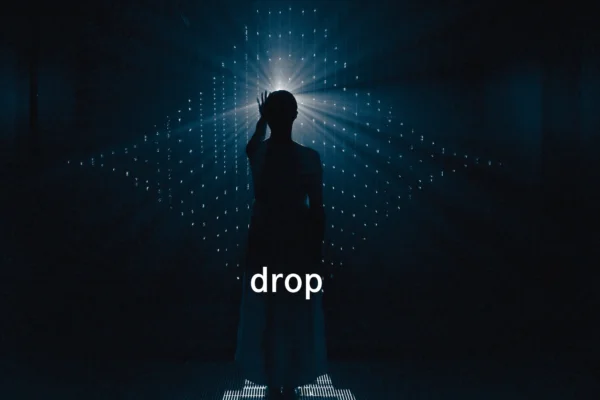
AnimationArt workInstallationInteractiveProjection mappingWater screen drop 2020 ~ 00:02:00 Description: An art piece created as the "Sea Room" at the Museum of Inhomogeneous Nature and People, located within Nagasaki Bana Resort Campground in Bungotakada City, Oita Prefecture, using water-drop projection mapping. By combining a water-drop fountain performance by Water Pearl Co., Ltd. with an ultra-high-speed projector from Tokyo Electron Device Limited, the work achieves precise projection mapping onto a continuous stream of falling water droplets. This new technology, which has been patented internationally, makes it possible to display animations that smoothly move individual water droplets up and down—something that could not be achieved with conventional Water Pearl installations using strobe lighting. These water droplets are real water that can be touched.
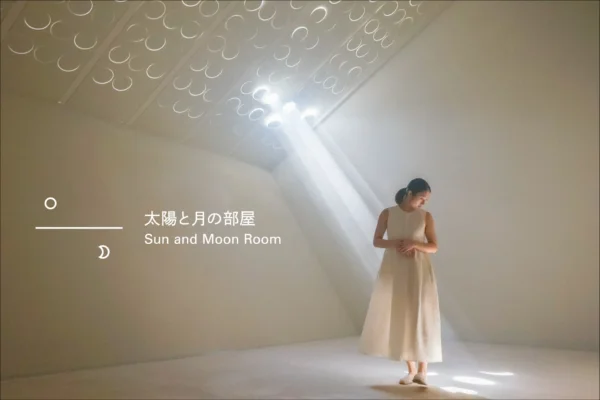
Art workInstallationInteractiveKinetic The Room of the Sun and Moon 2020 ~ 00:07:36 One of the interactive artworks created around the theme of engaging with nature and expanding physicality, housed in the “Museum of Inhospitable Nature and Human,” established in Bungotakada City, Oita Prefecture. This work is conceived as a room where visitors can play with sunlight. As visitors walk through the room, the small openings in the ceiling automatically open and close, enveloping their bodies in light, while the patches of sunlight on the floor constantly change shape, like the waxing and waning of the moon, in response to the opening and closing of those openings. The viewer’s position is detected by sensors, and only the small openings on the side facing the sun are activated. In addition, the interior is adjusted by analyzing weather data from the Japan Meteorological Agency, so that the most suitable effect is produced at any given moment: on sunny days, mist fills the room and shafts of light can be seen streaming down to the floor. Moreover, piano notes sound when the small openings open, and a piano piece is performed as visitors walk through the room. In this work, the technology is not directly presented; instead, it is used solely to capture sunlight and deliver it directly onto the viewer’s skin, allowing them to feel nature. Rather than artificial light, natural light is delivered to the viewer, evoking not only sight but also the warmth that light holds, and designed to sharpen the senses and awareness of those who experience it.
InstallationInteractiveProjection mapping The Wall of Discovery 2017 00:00:46 Science advances by asking “why?”, letting our imaginations grow into hypotheses, and repeating experiments while believing in those hypotheses. “Discovery Wall” was created as a warm-up before entering the Basic Exhibition Room at the Fukuoka City Science Museum, to encourage visitors to question everything and let their imaginations run free. To inspire people to explore with curiosity—wondering “What happens if I touch this picture?” or “What does this picture mean?”—we incorporated many intriguing devices into the content, based on events in the history of science and scientific phenomena, and freely imagined by animation creators. When you touch the reliefs, science and imagination burst forth as delightful animations. Each one connects and interacts, eventually converging into the question: “Why?”
Art workInstallationInteractive Spacetime’s Tail 2014 00:03:01 “Tail of Spacetime” was created as an artwork for experiencing the concept of spacetime. Through Minkowski’s light cone, we are always present at our current point, gazing at the horizon of possibilities expanding into the future at the speed of light. When you touch the “Tail of Spacetime” placed at the center of the work’s space, you can see, within the concept of spacetime, the trajectory of how you arrived at your present location. The space is three-dimensionally scanned by sensors placed in front, and by comparing the positions of the past and present space, it generates in real time an image that makes it seem as though your past self exists in the same space as your present self. Manipulating spacetime through visual effects has been achieved by SF films such as Back to the Future, manga such as Doraemon, and experimental works such as Norman McLaren’s Canon, Zbigniew Rybczyński’s Tango, and Michel Gondry’s music video for Kylie Minogue’s Come Into My World. But what it actually feels like had, until now, only been something we could imagine. By imagining, people can perceive the real world in a new way and transform it. The concept of spacetime is still very new, but with its emergence, the way we perceive our world has changed greatly as well. “Tail of Spacetime” is still an experience within video, but as technology continues to advance, I believe it may not be far off before it leaps into physical space. I look forward to seeing what kind of world lies beyond the ability to experience spacetime with our own skin.
InstallationInteractive Cry Art 2018 00:01:01 Even for familiar animals, many people may never have heard the sounds they make. With that in mind, we created this content to introduce the animals at the Fukuoka City Zoological and Botanical Garden through imitating their calls. When you imitate an animal call into a speaking-tube-style microphone, the sound waveform changes and an artistic animal appears. AI machine learning is used as the technology to determine which animal the imitation corresponds to.
3DCGArt workInstallationInteractive Mimicry's Little Room 2019 00:01:11 Commissioned to create an installation for the masterpiece Alice in Wonderland, I wanted to create a space where visitors could feel as if they had entered the mysterious world within the story. The various unbelievable events Alice experiences are wondrous, but at the same time they are filled with the intellectual curiosity and excitement we felt as children—thoughts like “Wouldn’t it be great if this happened?” and “What if this happened?” For the installation, we wrote down countless “wouldn’t it be great if...” ideas and exchanged many proposals, and in the end we decided on the concept of John Tenniel’s beautiful illustrations coming to life and moving in response to the viewer. The small 2.5-meter-square room was designed as a “special place for connecting with Alice’s world.” Inside the 14 frames hanging on the walls are iPads, each displaying a character from Alice’s story. Based on John Tenniel’s original illustrations, 3D model data was created for the characters, and through shader programming, real-time image processing makes them look like paintings drawn with hatching techniques, so at first glance they appear to be ordinary framed artworks. When a person stands on the carpet in the center of the room, a Kinect v2 sensor detects their pose, and all the characters in the frames slowly begin to move and “mimic” the person’s stance. The playfulness that fills Alice’s world contains many suggestions for the way we live and work today. Dutch historian Johan Huizinga argued that “play” is the essence of human activity and the source from which culture arises. French philosopher Roger Caillois developed this view of humanity, identifying mimicry, meaning “imitation,” as one of the four fundamental elements of play, and noting that it played a particularly important role in primitive societies. In addition, in Mozart, Hideo Kobayashi points out that Mozart was a genius of imitation, and that his original music was born out of imitation. We can discover many things through play and develop culture. We created this work in the hope that many people, through the story of Alice and this exhibition, would feel the importance of filling everyday life with more play.
2D animationTV-CM QTnet [BBIQ] Connect-kun ~Mandala Edition~ 2023 00:00:15 A commercial for BBIQ fiber-optic internet featuring QTnet’s characters. Two versions were produced: the “Mandala” version and the “Connecting” version. It richly incorporates the local feel of the Kyushu area and the chaotic nature of the internet. Combined with the contrast from the gentle, cute worldview of the Connect-kun characters, the result is an ad video with a huge impact.



![QTnet [BBIQ] Connect-kun ~Mandala Edition~ - 映像作家: kooki](https://eizo100.jp/w/wp-content/uploads/2024/04/BBIQ3-600x337.jpg.webp)