Art workInstallationInteractiveMovie
Catch and Collect: The Forest of Extinction
2025
00:02:15
An educational project conceived as a way to explore, discover, catch, observe, gather knowledge, and expand curiosity with one’s own body.
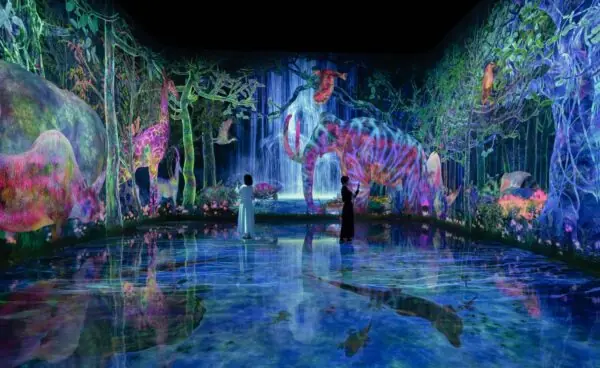
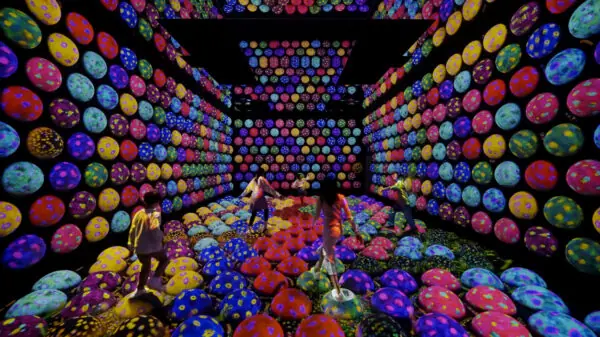
In the Forest of Extinct Animals, extinct animals live. When you approach or touch the animals, they run away or turn around. You catch various kinds of extinct animals, observe them, and build your own collection encyclopedia.
Using the smartphone camera, you look at the animals walking through the space, and when you cast the “eye of observation” at the animal visible on the screen, it flies into the real space. When the “eye of observation” hits the animal, it disappears from the space and enters your smartphone, where it is collected.
When you swipe a captured animal to a place visible through the camera, it is released and returns to that spot.
Also, if you cast an “observation net” wherever you like, an “observation net” will be spread at your feet. Working together with the people around you and using your body to drive the animals into the “observation net,” the animals disappear from the space and are collected in the encyclopedia in the same way.
The collection encyclopedia fills in more detailed information the more times you catch the same animal.
Work page: An educational project conceived as a way to explore, discover, catch, observe, gather knowledge, and expand curiosity with one’s own body.
In the Forest of Extinct Animals, extinct animals live. When you approach or touch the animals, they run away or turn around. You catch various kinds of extinct animals, observe them, and build your own collection encyclopedia.
Using the smartphone camera, you look at the animals walking through the space, and when you cast the “eye of observation” at the animal visible on the screen, it flies into the real space. When the “eye of observation” hits the animal, it disappears from the space and enters your smartphone, where it is collected.
When you swipe a captured animal to a place visible through the camera, it is released and returns to that spot.
Also, if you cast an “observation net” wherever you like, an “observation net” will be spread at your feet. Working together with the people around you and using your body to drive the animals into the “observation net,” the animals disappear from the space and are collected in the encyclopedia in the same way.
The collection encyclopedia fills in more detailed information the more times you catch the same animal.
Work page: https://www.teamlab.art/jp/ew/collecting-forest-planets/planets/