Sculpture Without Mass or Form - 映像作家: teamlab
Art workInstallationMovie

Sculpture Without Mass or Form

2020 ~
00:01:24
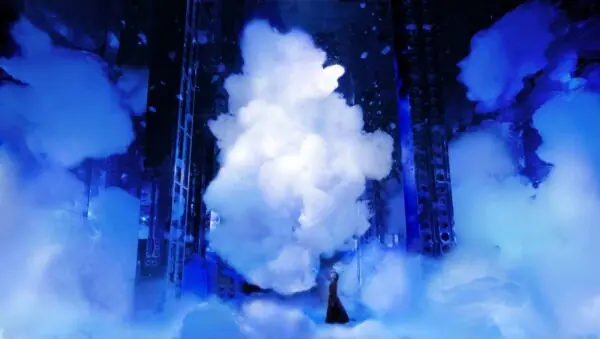
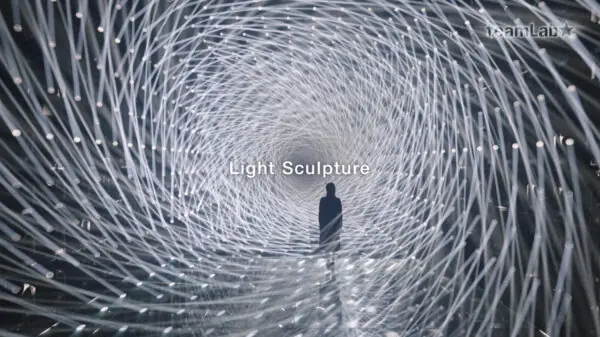
Floating in the air, a colossal sculpture is born from a sea of foam, transcending the concept of mass. It neither sinks to the ground nor rises all the way to the ceiling, but drifts somewhere in the middle of the space. The outline of this floating sculpture’s existence is ambiguous; it can break apart into smaller pieces or merge together into a larger mass. Even if a person enters it with their whole body, its existence is maintained, and even if it is broken by people, it repairs itself. However, when the mass is destroyed beyond the range it can repair on its own, the repairs cannot keep up and it begins to collapse. And even if people try to push it or move it aside, they cannot move this sculpture; if people fan wind at it, the sculpture will scatter. No physical action by humans can even move this sculpture. Pebbles, and things humans have made up to now, are objects, and objects have stable structures in themselves. A pebble continues to exist even if placed in a sealed box cut off from the outside world. By contrast, a vortex born in the sea disappears instantly when moved into a closed box. In other words, a vortex does not maintain a stable structure of its own. A vortex is an existence within the flow created by its environment, formed by water that continuously flows from outside the vortex to inside, and from inside to outside. Sustained by the structured order generated by that flow, the vortex continues to exist and changes along with the flow. And the outline of its existence is ambiguous: both the vortex and the outside of the vortex are made of water, with no material difference at all. Instead of creating objects, by creating a special environment, existence is created through the order of energy generated by that environment. Let us call existence formed by this order of energy “Higher-Order Sculpture.” It cannot be separated from its environment and changes as the environment changes. It transcends the conventional understanding of existence based on objects, maintains its presence in midair, and has an ambiguous outline. Even if a person enters it with their whole body, its existence is maintained, and if it is broken, it repairs its own existence. It is a sculpture premised on an open system. In this space, the only matter that exists is water, air, and ordinary soap. By filling the space with foam, creating a singular environment, and generating an order of energy within it, a colossal mass is born from the sea of bubbles, rises up, and remains suspended in midair. In current biology, it is not possible to define life strictly, but for convenience, living things are called organisms if they are composed of cells, metabolize, and can self-replicate. In other words, all living things are made of cells. And all cells are enclosed by cell membranes composed of lipid bilayers. The outside of the bilayer is hydrophilic, the space between the layers is hydrophobic, and both the outside and inside of the enclosing sac are water. Soap bubbles are similarly enclosed by membranes made of lipid bilayers, and the bubbles that constitute this sculpture are structurally the same as cell membranes. However, unlike cells, the outside of the bilayer in a bubble is hydrophobic and the space between the layers is hydrophilic, so both the outside and inside of the sac are air. In other words, if a cell is a sac-like membrane in water, a bubble is a sac-like membrane in air. This sculpture is created from matter with the same structure as cells, the basic units of living organisms, and from the order of energy generated by the environment. Life, too, takes in matter and energy from outside as food, expels matter, and dissipates energy outward while forming ordered structures. Like a vortex, life is an existence within the flow of matter and energy created by the external environment, and the outline of its existence is ambiguous. The structure of life is the order of energy created by that flow, and life may be a miraculous phenomenon found within the flow of matter and energy. Artwork page: https://www.teamlab.art/jp/ew/masslesssculpture-kyoto/kyoto/

Catch and Collect: The Forest of Extinction - 映像作家: teamlab
Art workInstallationInteractiveMovie

Catch and Collect: The Forest of Extinction

2025
00:02:15
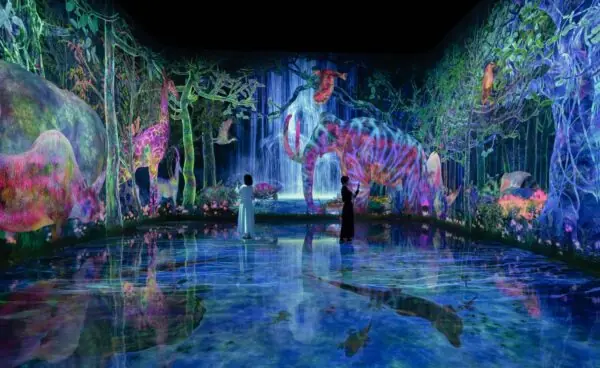
An educational project conceived as a way to explore, discover, catch, observe, gather knowledge, and expand curiosity with one’s own body. In the Forest of Extinct Animals, extinct animals live. When you approach or touch the animals, they run away or turn around. You catch various kinds of extinct animals, observe them, and build your own collection encyclopedia. Using the smartphone camera, you look at the animals walking through the space, and when you cast the “eye of observation” at the animal visible on the screen, it flies into the real space. When the “eye of observation” hits the animal, it disappears from the space and enters your smartphone, where it is collected. When you swipe a captured animal to a place visible through the camera, it is released and returns to that spot. Also, if you cast an “observation net” wherever you like, an “observation net” will be spread at your feet. Working together with the people around you and using your body to drive the animals into the “observation net,” the animals disappear from the space and are collected in the encyclopedia in the same way. The collection encyclopedia fills in more detailed information the more times you catch the same animal. Work page: An educational project conceived as a way to explore, discover, catch, observe, gather knowledge, and expand curiosity with one’s own body. In the Forest of Extinct Animals, extinct animals live. When you approach or touch the animals, they run away or turn around. You catch various kinds of extinct animals, observe them, and build your own collection encyclopedia. Using the smartphone camera, you look at the animals walking through the space, and when you cast the “eye of observation” at the animal visible on the screen, it flies into the real space. When the “eye of observation” hits the animal, it disappears from the space and enters your smartphone, where it is collected. When you swipe a captured animal to a place visible through the camera, it is released and returns to that spot. Also, if you cast an “observation net” wherever you like, an “observation net” will be spread at your feet. Working together with the people around you and using your body to drive the animals into the “observation net,” the animals disappear from the space and are collected in the encyclopedia in the same way. The collection encyclopedia fills in more detailed information the more times you catch the same animal. Work page: https://www.teamlab.art/jp/ew/collecting-forest-planets/planets/
A Massless Sun and a Sun of Darkness - 映像作家: teamlab
Art workInstallationInteractiveMovie

A Massless Sun and a Sun of Darkness

2022〜
00:01:45
We do not perceive the world we see. We see the world we perceive. Countless spheres of light. As people approach the spheres of light, they shine more intensely, and the surrounding spheres respond in turn, continuing one after another. If you widen your field of view and stare, spheres of darkness, like lumps of darkness that has solidified, also begin to appear. However, these spheres of light and darkness do not exist. The spheres of darkness do not even appear on camera. Nothing such as glass or any other object is present on the surface of the spheres of light; these spheres are made only of light. There is no material boundary surface, and the boundary between the sphere and the body remains ambiguous in perception. However, in this universe, light does not solidify, and it never forms into spherical masses by itself. In other words, these spheres of light do not exist. These spheres are not present in the physical world, but are sculptures that exist in the world of perception: "Cognitive Sculpture / Sculptures of Perception." Their material consists of light, the environment, the body, and perception. Shaped by the experiencer’s own dynamic body and perception, they appear and exist in the experiencer’s own perceptual world. When they exist in perception, that is existence. And the spheres cannot exist even in the world of perception on their own; they are created by the environment. The phenomena produced by the environment are the existence of the work. Work page: https://www.teamlab.art/jp/ew/masslesssuns-phenomena/phenomena/
Order in Chaos - 映像作家: teamlab
Art workInstallationInteractiveMovie

Order in Chaos

2025
00:01:45
Color strokes are not grasped as a whole by anyone, nor are they directed, nor are they influenced from outside. As simple interactions arise locally between strokes, or between strokes and people, order continues to emerge on its own while moving toward disorder. Even if each one is separated in time and space, once order emerges among them, the constituent elements transcend spacetime and appear as a single existence. And even if their shapes and sizes undergo major superficial changes, or if the constituent elements are replaced, this spacetime existence is maintained. This spacetime existence is part of the sea of disorder, is swallowed up by the sea of disorder, and yet continues to be born again from the sea of disorder. Order and disorder, existence and the whole, have no boundaries and are continuous; they collide and blend together, yet keep rising and receding. Images created through lenses and perspective are spatial illusions that render three-dimensional space on a two-dimensional plane. Three-dimensional space appears beyond the two-dimensional plane, and that three-dimensional space and the viewer are separate spaces, with the two-dimensional plane serving as the boundary. The viewpoint is fixed, and the body is lost. Unlike these, this work is not a spatial illusion; the work space exists as it is in the same space as people’s bodies. Walls and floors do not become boundary surfaces between the viewer and the work space; the work space becomes one with the space occupied by people’s bodies. The viewer’s viewpoint is not fixed, and the body is free. Work page: https://www.teamlab.art/jp/ew/order-chaos-phenomena/phenomena/
Transforming Continuum - 映像作家: teamlab
Art workInstallationMovie

Transforming Continuum

2025〜
00:03:09
Even when each component is separated in time and space, if an order emerges among them, the components transcend spacetime and a singular existence appears. And even if its form and scale undergo dramatic surface-level change, or all of its components are replaced, that singular existence is maintained. This spacetime-based existence is a part of the whole, born from the whole, and returns to the whole. A living cosmos of temporal-spatial existences. An existence is born in space. It is born on the ground as a mass, rising up from the ground. It also appears in the air, transcending the concept of mass, and continues to exist fixed in midair. The contours of these existences are vague, and the glowing spheres that compose them are constantly replaced. Even if a person enters this existence with their whole body, the existence is maintained; even if it is broken by people, it repairs itself. And even if people try to push it or move it aside, the existence cannot be moved. Human physical actions cannot even budge this existence. Rather than creating an object, by creating a special environment, one creates an existence through the order of energy generated by that environment. Let us call these “Higher-Order Sculpture.” It cannot be separated from the environment, and changes along with environmental change. It transcends the conventional notion of existence as an object, remains present in midair, has vague contours, maintains its existence even when a person enters it with their whole body, and repairs its own existence when broken. This is sculpture premised on an open system. Work page: https://www.teamlab.art/jp/ew/morphingcontinuum-kyoto/kyoto/
Multi-Jumping Universe - 映像作家: teamlab
Art workInstallationInteractiveMovie

Multi-Jumping Universe

2022〜
00:01:29
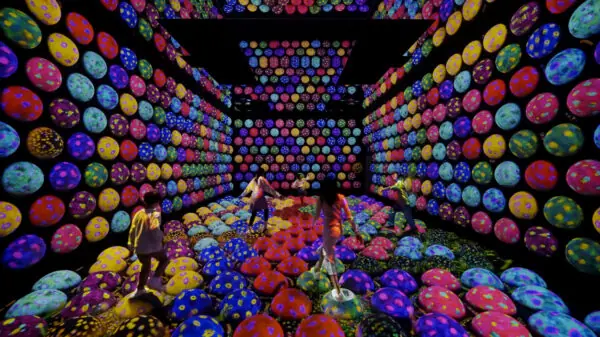
Description: “Multi Jumping” is an elastic floor that lets you bounce. The ground beneath you sinks, and you can jump higher than usual. When you step on “Multi Jumping,” the floor beneath your feet sinks, creating a distortion in space-time where stardust gathers and a star is born. If you bounce on the star, it begins to move. By continuing to bounce on the moving star as you chase it, the star grows and you experience the life of a star. When a star reaches the end of its life, it turns back into stardust, becoming the source of a new star. When it grows extremely large, the star becomes a black hole, drawing in the surrounding stardust and stars. Background of the work The life of a star Stars that emit their own light, like the sun or the stars shining in the night sky, are called “stars.” In the universe, there are many different kinds of stars, such as “planets,” like Earth, on which we live, and “satellites,” like the moon, that orbit around them. Here, however, we will talk about “stars” that emit their own light. A key factor in the life of a star is “gravity.” According to Einstein’s theory, in the universe, the mass of objects creates distortions in space-time. The force that causes surrounding objects to gather as if drawn toward these distortions in space-time is called “gravity.” The birth of a star In the universe, vast amounts of stardust and gas drift about, and when they gather under gravity, they form the embryo of a star. The state immediately before something becomes a star is called a “protostar.” The evolution of a star A “protostar” gathers surrounding stardust and gas through gravity and evolves into a shining star. A star at this stage is called a “main-sequence star.” Stars spend most of their lives as main-sequence stars. The sun we see is currently at this stage. As it evolves further, the star begins to swell and becomes a large red star called a “red giant.” The end and rebirth of a star If a star has a mass less than about eight times that of the sun, it releases gas and ends its life. If it is more massive than that, it ends its life in a “supernova explosion.” A star is blown apart by a supernova explosion, turning back into stardust and gas, which then becomes the material for the birth of the next star. Work page: https://www.teamlab.art/jp/ew/multijumpinguniverse-planets/planets/
teamLab Phenomena Abu Dhabi - 映像作家: teamlab
3DCGArt workInstallationInteractiveMovie

teamLab Phenomena Abu Dhabi

2025
00:05:27
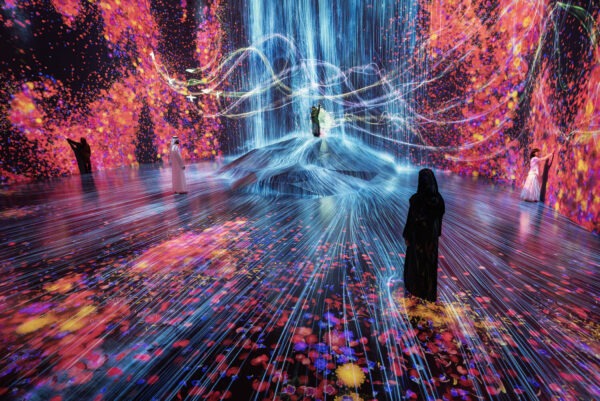
Environment gives rise to phenomena, and phenomena create the work. Immersed in that new body of works, one becomes one with the environment. The work cannot exist on its own; environment gives rise to phenomena, and phenomena create the work. Pebbles and the things humans have made until now have been objects. Objects possess a stable structure in themselves and, separated from the outside world, continue to exist even when placed inside a sealed box. A vortex born in the sea, on the other hand, disappears the moment it is transferred into a closed box. A vortex does not maintain its structure by itself; it exists only within the flow created by its environment. It is formed by water that continuously flows from outside to inside, and from inside to outside, changing along with the flow. Its contours are indistinct, and there is no material difference between the vortex and the world outside it. Rather than making objects, create a special environment, and create works through the phenomena that environment brings forth. Let us call this “environmental phenomena.” Works cannot be separated from their environment; they change as the environment changes. Works are liberated from the material objects that have so far carried their existence. Even the ordinary things of everyday life—air, water, light—will become phenomena through unique environments, transforming into a new kind of existence. Transcending the common sense of what humans have made until now, works will retain their existence even when people enter them bodily, and will be repaired when broken. The boundaries of a work’s existence are indistinct and continuous with what lies outside it. However, if the environment is lost, the work will disappear. Human consciousness will expand from existence itself to the environment. Exhibition details: https://www.teamlab.art/jp/e/phenomena/
Dissipative Figures – 1000 Birds, Light in Dark - 映像作家: teamlab
3DCGArt workInstallationInteractive

Dissipative Figures – 1000 Birds, Light in Dark

2023
00:01:43
The outline of life’s existence is not the boundary of the physical body, but something ambiguous that also includes the environment continuous with it. As long as life is alive, it dissipates energy and moves the surrounding environment, such as the air. This work depicts the existence of a flock of birds through the energy the flock has given to the world. The existence called “I” is the mind, the body, and the environment continuous with them. A pebble, and things that humans have made up to now, have stable structures in and of themselves. Life, however, is different. A pebble will continue to exist even if it is placed in a sealed box cut off from the outside world, but life cannot maintain its existence when placed in such a closed box. Life is like a vortex born in the sea. A vortex is an existence within a flow, and the boundaries of its existence are ambiguous. In fact, a vortex is in a steady state, yet continues to writhe and appears like a single powerful living being. A vortex is not something that maintains a stable structure on its own; it is created by water continuously flowing from outside the vortex to inside it, and from inside to outside, and its structure is sustained by that flow. Life, too, takes in matter and energy from outside as food, releases matter, and dissipates energy outward while building an ordered structure. In other words, the structure of life is formed not by life itself, but by the environment continuous with it. Life is a miraculous phenomenon that arises in the flow of an open world, and like a vortex in the sea, it exists within an infinite continuum, with ambiguous boundaries to its existence. To be alive is to continue dissipating energy into the world and to remain continuous with the world. Work page: https://www.teamlab.art/jp/w/dissipative_birds/himeji/
Possessed Flame: Born in Darkness, Vanishing in Darkness - 映像作家: teamlab
3DCGArt workInstallationInteractive

Possessed Flame: Born in Darkness, Vanishing in Darkness

2021, 2024
00:02:26
Description: Clusters of spacetime stand in abundance, and each cluster connects with the spacetime of the others. Within the mass of darkness, they begin to burn, then return to darkness again and again. They affect the surrounding area. When people stand before the flames burning inside the clusters, a black, absolute presence appears. Flames are a phenomenon of light and heat generated by combustion; they are also vaporized or decomposed matter within a flow, and an experiential sensation we perceive when seeing the boundary between phenomenon and substance. People recognize flames, an experiential sensation, as though they were a single object, and sometimes feel life within them. By the flow of combusting gas in clusters of spacetime, lines are drawn in space, and flames are created from the three-dimensional aggregation of those lines, then flattened by teamLab’s concept of a “super subjective space,” and the flames are rendered. teamLab is exploring the concept of “Distributed Art.” When you approach the flames of the work with the 《Distributed Fire》 app, a flame lights up on your smartphone, and you can take the work home with you. When you bring that carried flame near another person’s smartphone, a flame will light up there as well. By connecting the flame to someone else, and then to someone else again, the flames spread throughout the world. The entire expanding cluster of flames is drawn on the Flame Map. In Distributed Art, some works replicate themselves, while others share part of themselves with people. A work that has been passed into people’s hands will again generate its own replicas, as people actively disperse it. The work exists in a distributed way across people’s networks, and will become a decentralized art form. When the work exists on the network, it continues to exist even if the original disappears. Work page: https://www.teamlab.art/jp/ew/fireparticles-darkness-jeddah/jeddah/

Loading...

No more content

Error loading content