山村浩二

山村浩二

unverified
Category
Producer
Status
Claim this profile

Work

Oni and Yanari House Rattler - 映像作家: Shinobu_Soejima
AnimationLive actionShort filmStopmotion

Oni and Yanari House Rattler

2018 ~, 2019
00:06:27
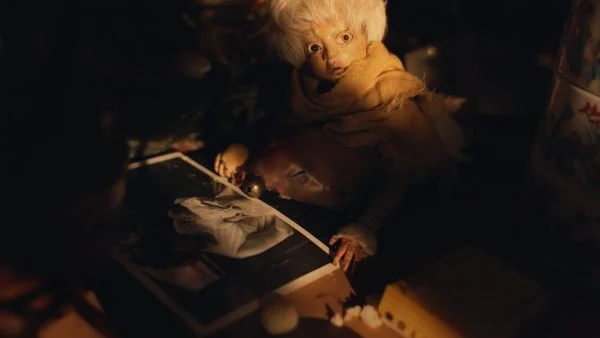
For a long time, every house in this country was inhabited by the yokai known as Yanari, or “house-rattlers.” But as wooden houses gradually fell into decline, they came to be inhabited only by the hard of hearing elderly, and the voices of the house-rattlers could no longer be heard. The house-rattlers sometimes feel lonely about that. The protagonist of this work is a small yokai, only a few inches tall, called “Yanari,” which appears in Japanese folklore. It has long been believed that the strange creaking and other mysterious sounds sometimes heard inside houses are the work of these beings, who try to startle the residents. In Japan, people have long believed that the homes they live in, like the house-rattlers, contain unseen shadowy aspects, and they have feared them, calling them “oni” and treating them as something distant from everyday life. Today, this culture is fading, and the residents who once sensed “oni” have grown old, as if living on the side of the oni as shadows of modern, bright society. This work is a video piece that depicts the figures of elderly people being left behind by contemporary society and creatures from folklore, using effects of shadow and light. This is an animated work shot by physically moving dolls on location in my grandmother’s 80-year-old house in a depopulated port town. That house had long accepted and seen off many residents over its 80-year history, and because it still bore traces of the lives they had lived there, I always felt the presence of something “uncanny” whenever I heard a house-rattler in the house, and as a child I was always afraid. In this work, faint natural light, shadows, and the contrast of light and dark shining through the transom were used to create effective boundaries between bright and dark areas inside a Japanese house. I attempted to recreate the folklore creature moving between light and shadow using actual dolls, making it seem as if it truly existed. By filming the dolls at their actual size as the scale of “Yanari,” I aimed to blend our everyday world with the world of animation, and to visualize the eerie presence lurking within the Japanese house.

Bone Nibble (Trailer) - 映像作家: honamiyano
2D animationAnimation劇場映画

Bone Nibble (Trailer)

2021
00:00:55
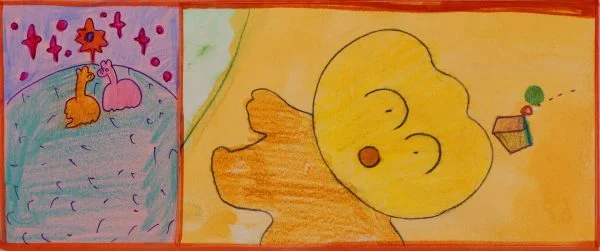
This work is an animation based on my past experience of confronting death for the first time, set on the Shimanami Kaido. In some regions across Japan, there is a custom called “honekami,” in which, after cremation, one eats the bones of the dead in an attempt to take them into oneself and overcome grief. Whether I wanted it or not, my family in my hometown had this custom. The first death I experienced was my father’s, but when I was made to try “honekami” as part of the ritual, I could not bring myself to chew the bones. That became a childhood trauma: an experience of being unable to face my father’s death directly, and not knowing how to accept it. Like an imaginary bone stuck in my throat, it could not be put into words, nor could it be forgotten. More than ten years have passed since I left my small, distant hometown at the age of 15. Fireworks storage buildings still remain along the island’s coast. The fact that there were fireworks magazines, rather than air-raid shelters, in my neighborhood made me feel that death and merciless violence existed for me not as something to be endured, but as something to be inflicted. When I think about these things as an adult, I came to link my father’s bones with the fire in the fireworks magazine, and decided to face “honekami” once again. The island’s landscape and sea are full of life, and within their calmness there is an unchanging severity. The shadows of the dead still exist in the same space and time, both now and in the past. Through this project, by blurring the boundary between life and death, I sought to create a confrontation with the bones I could not chew. The visual concept of this project was to merge natural landscapes with childhood memories, and to visually bring memories to life through the accumulation of dots. For this reason, I used colored pens to layer pointillist dots on paper, then filmed the paper under a camera while placing it over transmitted light. In doing so, I hoped to entrust the haziness of memory and the emotions of childhood to the technique as particles of colored light.