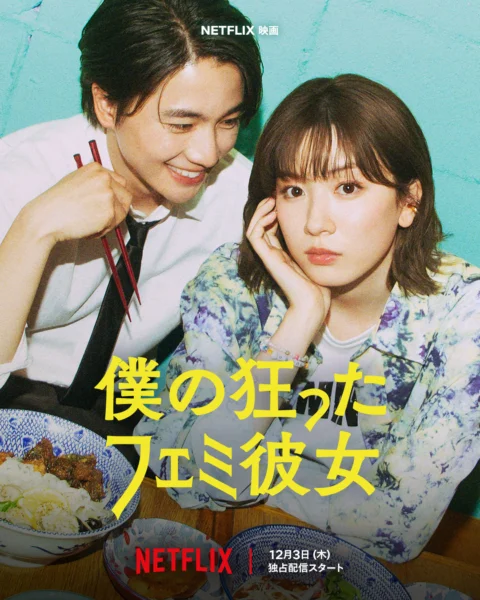
Web movie
My Crazy Feminist Girlfriend
2026
Only Image
Even though he loves her, he can’t understand her. Because he loves her, he wants her to understand him.
A value-gap romance comedy about a feminist girlfriend and a self-proclaimed kind boyfriend
Starring Mei Nagano.
With solid acting, she vividly brings to life “her,” a woman who became a feminist for a certain reason.
Playing the self-proclaimed kind boyfriend who wants to get back together with her is Taisei Kido.
He portrays Haruki, the former boyfriend who is still hopelessly in love with “her,” with a relatable, endearing charm as he’s tossed around by the girl he can never forget.
In the newly released footage, Haruki’s sweet recollections begin with the innocent, happy couple from their college days, accompanied by his lines: “You always smile so happily” and “I want to protect you.”
But seven years after their sudden breakup, the girl he once loved (“her,” played by Mei Nagano) unexpectedly appears before Haruki, who turns around after being called out to by her. What stands there is his first love, transformed in every way from the “cute, earnest girlfriend who healed me” he once knew—.
Even while struggling to accept that the woman he has reunited with has become a feminist, Haruki throws himself into trying to win her back because he loves her.
But whenever they meet face to face, they clash head-on over what is “normal” and what is “obvious.”
As a fast-paced battle of words unfolds, can the two of them, burdened by such a gap in values, really get back together!?
What does the message on the T-shirt, “GOOD GIRLS GO TO HEAVEN, BAD GIRLS GO TO EVERYWHERE,” mean—?
She was always smiling beside me—“her.”
But after one certain incident, Haruki is unilaterally dumped by his first love.
Even though he resents her, he can’t forget her. Seven years after their breakup, “her” still lingered in his heart.
Now a company employee working for a stationery manufacturer, Haruki one day encounters a group of women protesting on his way home from work.
The one who calls out to him there is the girl he once loved so deeply.
But the woman he reunites with is nothing like the earnest, adorable “her” who once comforted him.
She’s become a feminist!?
To Haruki, who wishes, “I want to date you again,” “her” shuts him down flatly with, “No way.”
Whenever they face each other, a battle erupts over what is “normal” and what is “obvious.”
Can these two, whose values are completely out of sync, become lovers again?