GOTANDA KAZUKI

GOTANDA KAZUKI

unverified
Category
Animator Art Department Director Editor
Status
Claim this profile

Work

Phantom Siita "Rose-Colored Moon" (OFFICIAL MUSIC VIDEO) - 映像作家: kazukigotanda
Music videoPaper craftStopmotion

Phantom Siita "Rose-Colored Moon" (OFFICIAL MUSIC VIDEO)

2026
00:03:45
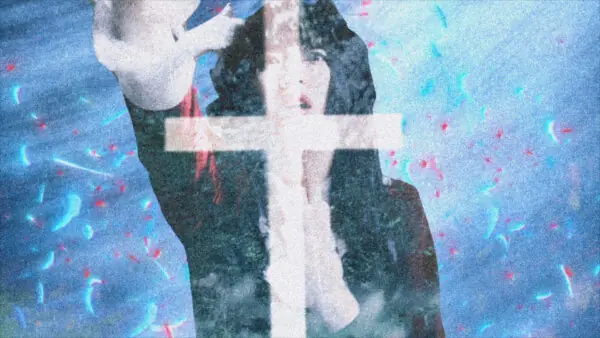
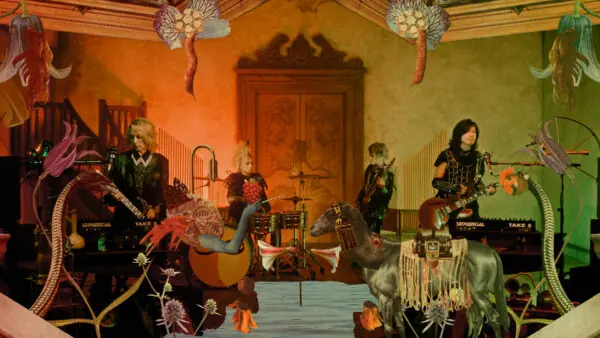
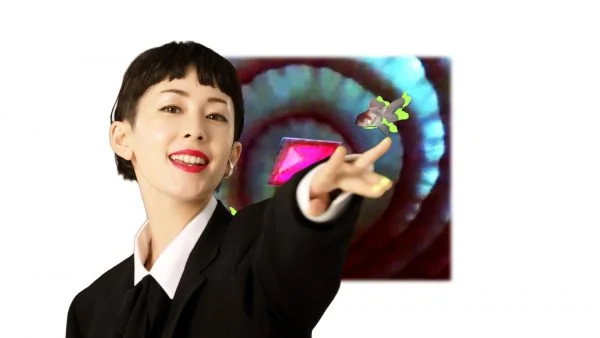
In this work, built around a new song by Phantom Siita, I sought to foreground the group’s aesthetic beauty and darkness while using Le Fanu’s vampire tale Carmilla as a motif, creating a world that unfolds like a Gothic short film. I had long thought that I wanted to make a vampire film at least once in my lifetime, and when I saw “Carmilla” written in a note from producer Ado, I was extremely excited. Among films based on Carmilla, Carl Theodor Dreyer’s Vampyr is one of my all-time favorites, and throughout this production I also kept thinking about the ashen, anemic pallor of Isabelle Adjani and Klaus Kinski in Werner Herzog’s Nosferatu, another vampire film. The setting is an old mansion that appears on a night of the full moon. Through the process of the girl Heine wandering into the mansion and getting swept up in the Phantom Siita’s—vampires’—festival, the film hints at an unnameable emotional wavering that cannot be clearly defined as romance, dependence, or illness. Visually, while drawing on European Gothic sensibilities and the decadent atmosphere of filmmakers such as Daniel Schmid, I aimed for a textured expression that combines live action and analog collage to depict “illness ≠ love.” That emotion is strictly not equal; here, I do not present it in an easy-to-understand way as “love is an illness.” By portraying, on the same plane, emotions that cannot be labeled—“I love you, I’m drawn to you, I want to hold on to you but I don’t want to, I want to run away, I want to live, I want to die, and I don’t want to die either”—alongside a body that grows weaker and more exhausted, I tried to express that this ungraspable feeling is real. As for the collage, rather than shooting against a green screen, we filmed in a studio filled with vintage props and similar items. Because the relationship between space and the people within it was necessary, and because collage needed to draw out that magnetic field in order to create a distortion of reality, I have lately tried to avoid using green screen as much as possible. By dismantling those elements, I wanted to portray a blurred consciousness and memory shaped by the dislocation of time and space. As for the collage method itself, we would print out live-action frames that had been shot and create animation while rearranging them, and even before shooting there were times when fragments of blurred consciousness, the mansion, or parts of scenes were assembled into analog collages.

Mameshiba no Taigun Tonai Bousho a.k.a. MONSTERIDOL “Shout out to good show!” Lyric Video - 映像作家: kazukigotanda
AnimationArt workExperimental filmMotion graphicsMusic videoPaper craft

Mameshiba no Taigun Tonai Bousho a.k.a. MONSTERIDOL “Shout out to good show!” Lyric Video

2024
00:02:11
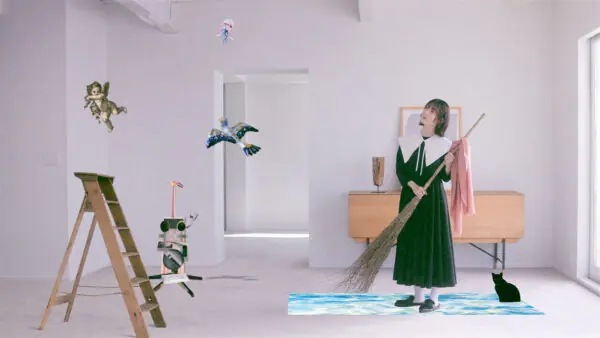
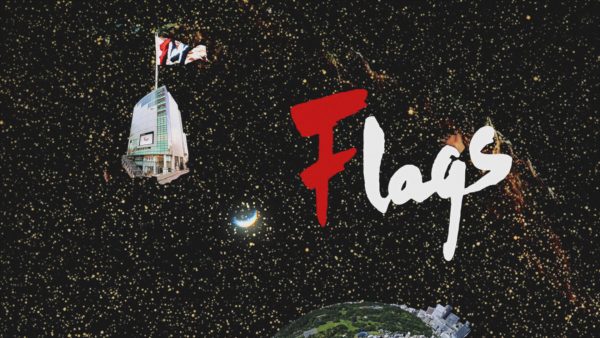
“Feel free to do anything as long as it’s not obscene.” With that request, I made sure the world of the music and the poem, its mood, and its forms would become as strange and disjointed as possible. The references I drew on were works that feel feverish and nightmarish to watch, such as Stephen King’s The Devil Truck, Sam Peckinpah’s Convoy, and Ken Russell’s Gothic. Above all, I wanted to express the absurdity of a gigantic thing racing at full speed, and the image of something that crosses some kind of limit or is mixed together until it turns into an uncanny form. If you trace the history of Gothic, from the Christian view of life and death to the monsters like gargoyles placed on church Gothic architecture, there is a sense of life and death repeating like summer and winter. I am always drawn to the coexistence of ambivalent things. The zombie in the passenger seat is always embodying the ambivalent state of life and death. Though dead, he wears a T-shirt that says “flesh and blood,” or gets an IV drip, as if he refuses to accept death. The method is my usual collage, but it is difficult to create something without straying from the world I have set up. The shape of the truck, on which I put special emphasis, also has to maintain a certain level of consistency from the front, the diagonal, and the side in order to connect properly. A lack of consistency is in a sense an inherent quality of collage, but this nauseating lack of balance was the most exciting and enjoyable part of my recent work.
Creepy Nuts / Daten Music Video - 映像作家: kazukigotanda
AnimationArt workMusic video

Creepy Nuts / Daten Music Video

2022
00:02:50
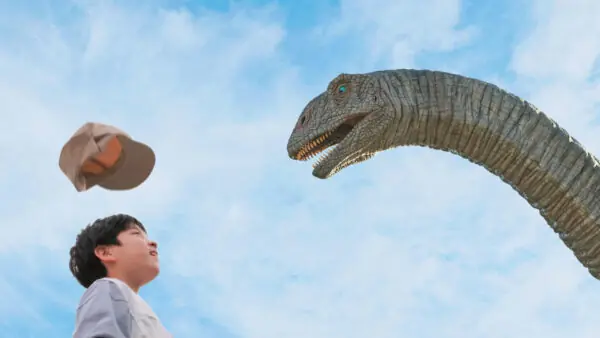
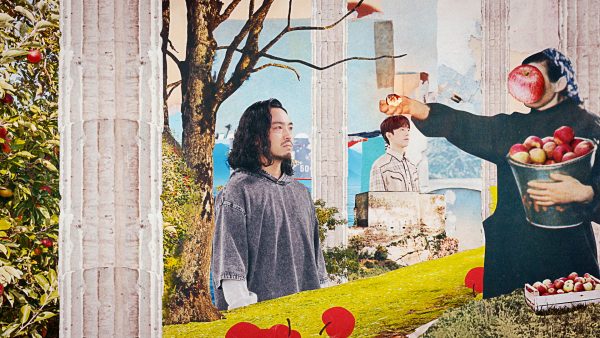
The aim was to create a direction that reverses the seemingly negative image of meeting through mistakes and presents it in a pop and positive way. Mistakes and errors are something everyone makes in life, and whether a judgment made at the time is right or wrong depends on the surrounding circumstances and the timing. In reality, when something happens, there is a time lag before you can take it in and make sense of it. In the midst of that, people often go through situations that seem inexplicable and cannot be clearly judged as right or wrong. By rolling along and falling like that, we directly expressed the image of “this is life, and yet there is something compelling about it, and it’s not all bad,” in sync with the lyrics. Being unable to resist and getting totally absorbed in something is neither justice nor evil, but a helplessly human side of us; it can be a mistake, or it can be desire. From there, the first image that came to mind was “missing an aerial trick in a circus.” Also, since a circus is on tour, I had a slight image in mind of messy romantic entanglements developing among the performers during that time. Also, in terms of falling from heaven to earth, and because this was pop music x hip-hop, the first things that came to mind were Wenders’ Wings of Desire and American pop art, so I referenced those. The quotation of Edward Hopper’s Nighthawks comes not only from the fact that the title is Night Owls (this work is the theme song for the TV anime Yofukashi no Uta), but also because it is frequently quoted in Wenders’ works. I also referenced the image of pop-art-style silkscreen prints and the imagery of Romare Bearden. In addition, when considering Creepy Nuts, I was mindful of their broad appeal, especially their exposure on variety shows, so the roulette was inspired by Jungle TV Tamori no Hōsoku, and the confession scene was inspired by Ore-tachi Hyokin-zoku.