3DCGAIAudio visual performanceEventExperienceInstallationInteractive
Expo 2025 Osaka, Kansai Signature Pavilion “null²”
2025
00:01:45
WOW participated in the signature pavilion “null²” at Expo 2025 Osaka, Kansai as part of the creator team, contributing to the planning, visuals, sound, and overall direction system. The pavilion’s theme is “Polishing Life.” WOW joined as a direction member from the earliest planning stages and, together with Expo producer Yoichi Ochiai, spent several years creating a wide range of creative elements, from the pavilion’s interior visuals, sound, robot control, and experiential flow to the exterior visuals.
A Pulsating Sculpture, a Conversational Space
For this pavilion, Ochiai established “two mirrors” as a key concept. The first refers to the sculpture itself, which generates unfamiliar landscapes. Its mirror-finished exterior absorbs the surrounding scenery, pulsating as it repeatedly transforms like a living organism, even as a building. The second refers to the experience inside the pavilion. In a space where mirrors and imagery are integrated, visitors confront “kigō*” and engage in dialogue with a digital human. WOW was primarily responsible for this interior experience.
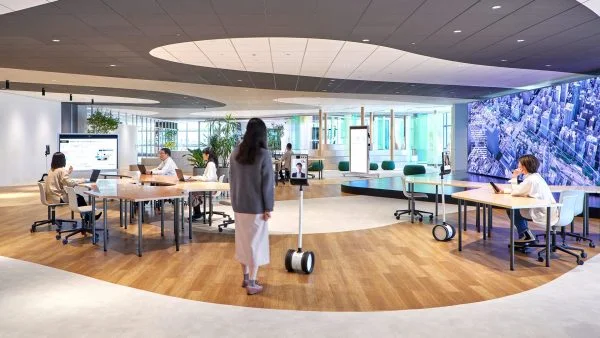
The space confronting “kigō” is a cube measuring 8 meters in width, depth, and height, with mirrored surfaces on all sides. Projection systems on the ceiling, floor, and walls, together with a vertical video object called the “Monolith” standing at the center, work in response to one another to depict “kigō,” creating endless reflections. In addition, the cube-shaped mirrored “goshintai,” which symbolizes the space, moves freely overhead, shifting perspectives and stirring the visitor’s mind and thoughts. Using mirrors as a medium, the experience moves back and forth between meaning and matter, self and other, reality and virtuality, encouraging visitors to reconsider and reinterpret what life is and offering a prompt to “polish life.”
*Elements that constitute a person’s individuality, such as their name, hobbies, preferences, voice, and appearance
Two Types of Experiences, Two Different Perspectives
The experience is offered in two modes: “Dialogue Mode” and “Installation Mode.” Dialogue Mode centers on the world of “computational nature,” as proposed by Ochiai, and the story connected to it, allowing visitors to let go of their “kigō” through verbal communication. In Installation Mode, visitors view simple patterned visuals, along with the Monolith and goshintai moving throughout the space, from the outer corridor, creating a non-verbal experience that lets them intuitively sense the structures at the essence of life. In both experiences, the story, visuals, sound, goshintai, and Monolith are all intricately linked, so WOW worked closely with Ochiai to craft a precise direction.
Direction Where Technology and Expression Merge
On the technical side, to create a more three-dimensional and densely layered experience, WOW integrated a wide range of direction elements, including AI-generated real-time video, display of 3D Gaussian splatting, sound generation, image effects, as well as the display and speech of MirroredBodies created by visitors in a dedicated app, and robot control for the goshintai and Monolith. In collaboration with various companies, WOW developed the main system that aggregates and controls these elements. In addition, the carefully designed sound direction, which makes use of characteristics across different frequency ranges, contributed to a unique auditory experience.
Logo Design and Design Guidelines That Create Organic Expression
WOW also handled the logo design for null². For the dynamic logo, multiple fonts were used to create a design that transforms into various forms. The static logo was refined from the dynamic logo as the official version. In both cases, the aim was to maintain a certain degree of legibility while pursuing a fluid, life-like design tone through verification and rule setting.
In this project, the participating teams, including WOW, brought together all of their technical capabilities and creativity to create the work “null²,” something that could only have been realized at the Expo.