Keita Abe

Keita Abe

unverified
Category
Developer / Programmer Director
Status
Claim this profile

Work

NIIGATA WONDER by PLATEAU - 映像作家: wow-inc
3DCGPromotionShort film

NIIGATA WONDER by PLATEAU

2024
00:02:06
About the Project As part of a technical tutorial on video production for the “PLATEAU” project promoted by the Ministry of Land, Infrastructure, Transport and Tourism, WOW was responsible for planning, producing, and directing a video work themed around Niigata Prefecture. PLATEAU provides 3D city models from across Japan as open data, helping to drive digital transformation in urban development and foster open innovation. In this project, we created a film, tutorial, and hands-on video using Niigata Prefecture’s 3D city model. Through this effort, we explored the creative potential and expressive possibilities of PLATEAU. Video Work “NIIGATA WONDER by PLATEAU” With the ظهور of a dragon, the god of water, mysterious gigantic objects begin to appear in various places across Niigata Prefecture. Their true identities are Niigata’s famous local specialties: Tochio Aburaage, sasadango, poppo-yaki, hegi soba, and snow crab. Guided by the dragon, these giant local delicacies eventually gather at Bandai Bridge in the center of Niigata City—. Combining a 3D model of Niigata City, live-action footage, and VFX, the work portrays the character and unique qualities of the city on a grand scale as a “fictional PR video.” PLATEAU PLATEAU is a project to realize digital twins of cities across Japan, promoted by the Ministry of Land, Infrastructure, Transport and Tourism in collaboration with a variety of stakeholders. It develops 3D city models as platform data for urban activity and creates use cases across diverse fields. In addition, PLATEAU provides 3D city models as open data so that anyone can freely access urban data. By advancing the development, utilization, and open-data deployment of 3D city models, PLATEAU aims to realize digital transformation in urban development and generate open innovation.
WOW25 "sonus-oleum ; Sonosorium" from Unlearning the Visuals - 映像作家: wow-inc
Audio visual performanceGenerative ArtInstallationInteractiveOriginalProjection mappingR&DReal-time Graphics

WOW25 "sonus-oleum ; Sonosorium" from Unlearning the Visuals

2022
00:03:23
About the Work “sonus-oleum ; Sonosorium” is a live installation in which visitors can experience works in different forms on each of the three floors of the ship-shaped facility (T-LOTUS M): B1F, 1F, and the rooftop. With the premise that “music becomes the energy that moves the ship,” the work explores the form of music born inside the ship through the following four formats. Live Performance 1 — The Birth of Music — This work begins with a live performance on B1F. The music is an original piece composed by Fumitake Ezaki specifically for this live installation. The performance is by Fumitake Ezaki (piano), Shuntaro Tsuneta (violin), Sonoko Muraoka (cello), and an automatic piano. The venue was designed with eight 3 m × 4 m screens installed on both sides of the performers, enveloping visitors in music and imagery. Real-time motion graphics synchronized with the instruments were projected onto the screens. The elements composing the real-time motion graphics are the piano’s output of keyboard input (88 keys), the strength and duration of pedal presses, and the hand movements of the violin and cello players captured using ring devices. The real-time motion graphics linked to the performers’ movements depict the energy of music being generated and floating upward to the upper levels. Interactive Installation — Variation through Images — The energy of the music born in the B1F live performance appears as bubbles within the interactive work on 1F. Seven 2.4 m × 2.4 m translucent screens were installed throughout the 1F space in alignment with the windows, and interactive visuals were projected onto them. When visitors touch the bubbles displayed on each screen, the bubbles split, and each note of the original piece transforms into a different timbre. Variations born from chance continue to be generated endlessly. Projection Mapping — Music Creates Wind — The variations generated on 1F rise further to the rooftop, where they create the wind that moves the ship. Using four large 30,000-lumen projectors, the wind stirred up by the power of music and striking the sails was projected above the visitors’ heads. Live Performance 2 — A Session with Returned Sound — In the second live performance held on B1F, the automatic piano played in real time the variations generated by visitors touching the bubbles on 1F, while Ezaki (piano), Tsuneta (violin), and Muraoka (cello) improvised along with it. The interplay of visitor-generated variations, improvised live performance, and real-time motion graphics evoked a new form of music. Through these four processes, this live installation created a landscape in which sound was “unlearned” and transformed into new sounds, continuing in circulation. The title “sonus-oleum ; Sonosorium” is a coined word combining sonus, meaning sound, and petroleum, meaning oil.
NISSAN PAVILION Yokohama - 映像作家: tatsuki-kondo
InstallationInteractive

NISSAN PAVILION Yokohama

2020
00:01:36
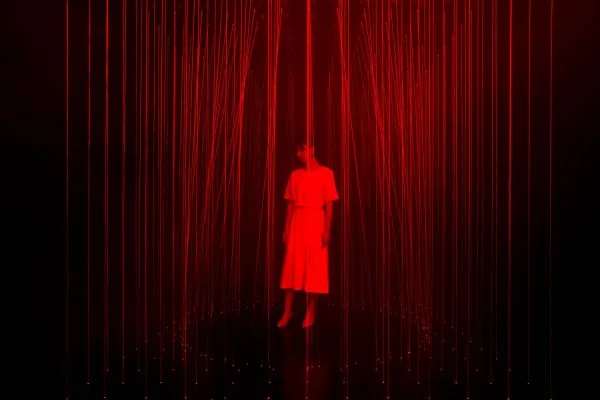
Nissan Pavilion, an experiential entertainment facility where visitors can experience Nissan’s proud technologies and vision for the future, opened for a limited time in Yokohama Minato Mirai. Its concept is “Expanding Human Possibilities.” Among the experiential content that gives form to a near-future made possible by Nissan’s technology, WOW was responsible for the direction and production of THE CITY area. Visitors can experience an installation inspired by a “city energized by the connection between cars, people, and society.” In THE CITY, two of Nissan’s envisioned futures were visualized within the space. ROOM1 In a smoke-filled space, 195 laser modules and the motors that move them were installed. Each laser is individually controlled to create a variety of animations, and when a visitor enters the area, the system detects their presence and takes evasive action, making it an interactive space. This abstractly expresses the key sensing technologies that Nissan is pursuing in order to realize a society with zero traffic accidents. ROOM2 Approximately 150 translucent pillars of varying heights, abstracting a “city,” and three pillars with mock car units placed on top, representing “cars,” were arranged throughout the space, with all pillars self-illuminated. The light animations representing “CHARGE,” “SHARE,” and “SUPPLY,” which begin when a hand is placed over the car mock-up, express Nissan’s vision of a city energized through the sharing of energy and information. In addition, when hands are placed over all three pillars with the mock-ups at the same time, a special effect triggers a vividly colorful light animation. The production was designed to evoke a city that becomes increasingly vibrant as cars, people, and society connect. Both spaces were designed as immersive environments that, while abstract, allow visitors to feel Nissan’s vision for the future. Nissan Pavilion Period: August 1, 2020 (Sat) – October 23, 2020 (Fri) Address: 6-2-1 Minatomirai, Nishi-ku, Yokohama-shi, Kanagawa NISSAN PAVILION Yokohama▶https://www.nissan.co.jp/BRAND/PAVILION/ For more detail▶https://www.w0w.co.jp/works/nissan_pavilion
Twin Concert - 映像作家: wow-inc
3DCGAudio visual performanceEventInstallationMotion graphics

Twin Concert

2020
00:03:31
With the theme of “reconstructing the orchestra through technology,” the “Yoichi Ochiai × Japan Philharmonic Project” launched in 2018. Again this year, WOW participated as the “performer of images” in the “____ Music Concert,” or rather, the “Twin Music Concert.” While the past two years had focused on creating a space where audiences could experience new appeal and value in the orchestra, this year the project sought to explore what an orchestra could be during the COVID-19 pandemic. In addition to a theater performance with a limited audience, the concert was also streamed online, aiming to offer a performance where new appeal could be experienced from two perspectives. In the theater performance, the audience experienced innovative music that opened up a new era of multidirectional sound in space, alongside image performers projected onto screens. In the online stream, the project pursued a sense of immediacy through concert-quality 2K video including AR imagery, industry-leading sound quality (AAC-LC 384 kbps), and three-dimensional visual direction made possible only through digital means. The visual experience of this performance centered on the AR imagery in the online stream, while the theater screens featured visuals that synchronized with, responded to, and contrasted with the AR imagery. Each offered a different yet equally valuable experience. In addition, by allowing theater audiences to later watch the online performance when it was re-streamed, the project sought to create a synergistic effect in which the performance could be relived from a different perspective. In visualizing the clues discovered through examining the music, the project did not rely on conventional notions of AR or stage visual direction, but instead aimed, as “image performers,” to create visual effects that accompanied the world of the music from two different perspectives, with the hope that each would be recognized as having its own new value. The title used up to just before the performance, “____ Music Concert,” was intended to express how the originally planned concert had been wiped away by COVID-19, and how a new concert was then pursued through trial and error. It also encouraged each viewer to think about the word that would fill the blank in the title. Near the end of the performance, the word corresponding to the “____” was revealed, and as the “Twin Music Concert,” a new concert was born from the search for what form a music concert could take during the pandemic.